Article · Field notes
Objects Born, Not Made
23 Feb 2026 4 min read

Almost twenty years ago, a Managing Director in San Francisco handed a very junior me a book that had nothing to do with my job.
I was there for a few months on a lucky break, wide-eyed and not knowing much about anything. The book was The Unknown Craftsman by Soetsu Yanagi, adapted by Bernard Leach. I didn’t read it straight away. When I finally did, it changed what I noticed.
“Anyone who is being moved by the beauty of folkcraft is, in reality, being moved by the invisible power that lies beneath the surface.”
— Soetsu Yanagi
The book is the manifesto of the Mingei (folkcraft) movement: simple forms, plain materials, everyday objects made without ego. Yanagi and Leach keep coming back to one idea, “objects born, not made.” Things that grow out of repetition, care and necessity, made by people who weren’t desperately trying to impress anyone.
(For more on Japanese craft philosophy, there’s a good reading list on Sentomono’s blog.)
I think about this a lot, in software, in engineering, in visual design. The most elegant code I’ve ever read has exactly this quality. It isn’t flashy, or clever for the sake of it. It feels inevitable, as if it couldn’t have been written any other way.
It all came rushing back recently, thanks to my eight-year-old, Noah.
His birthday’s coming up. He’d been eyeing my fitness watch for weeks, and then announced that he desperately needed one too.
Fair enough. But it rubbed me the wrong way. I pictured another screen on his wrist, buzzing with notifications, counting his steps for a week until the novelty wore off. One more object optimised for metrics instead of meaning.
I’d rather he was out living his physical life than tracking it on a screen. So I started steering him toward something he could actually hold.
Long story short (it took a lot of talking), we traded the smartwatch idea for a custom surfboard from the local legends at Santosha Surf.
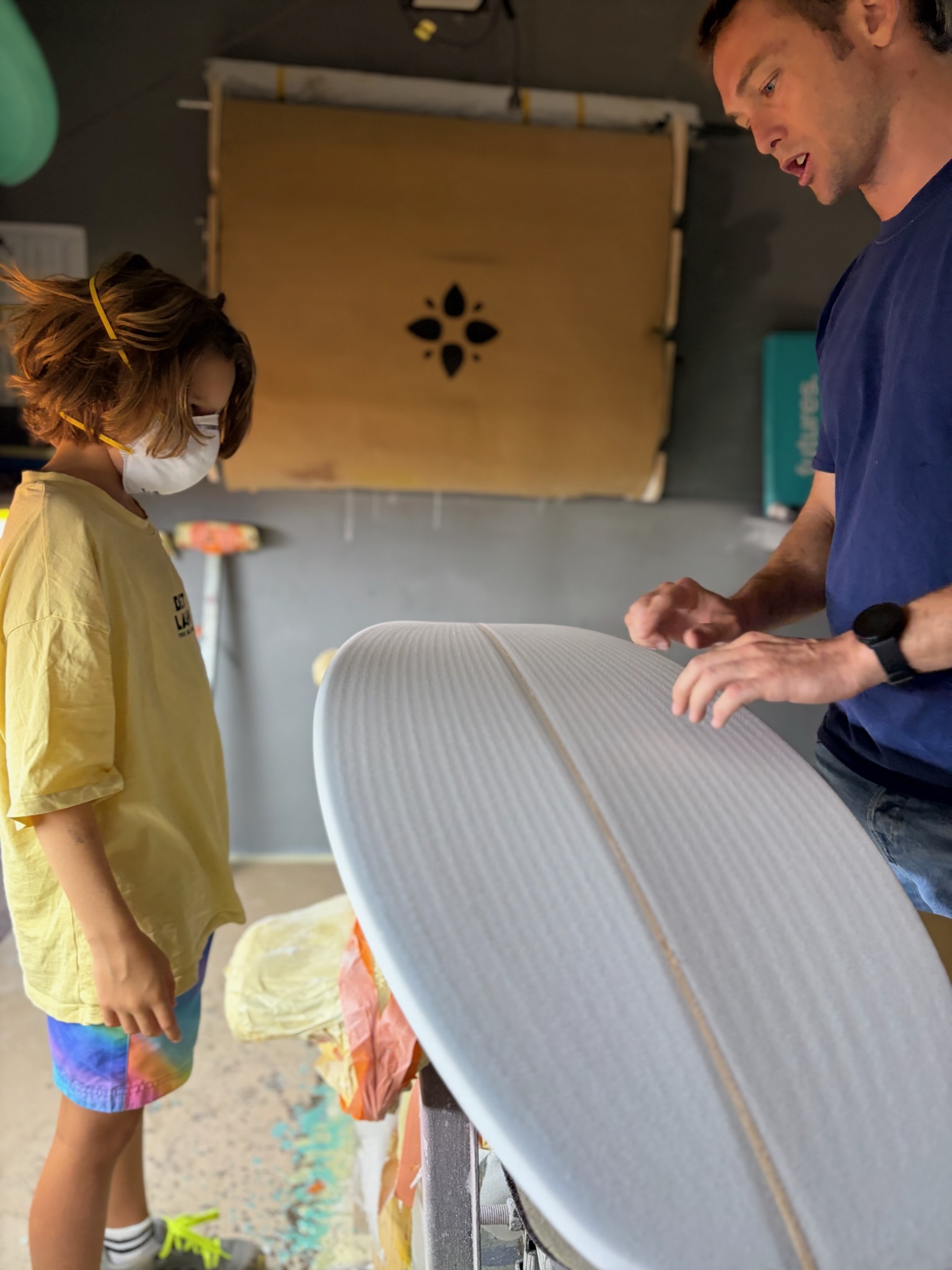
The watch would have been easy: pick a model, charge it, watch the novelty decay. The board was worse in all the right ways. Slower, messier, less certain, and impossible to outsource completely.
A few days ago we walked into their shaping bay. Instead of just ordering a board, I asked the shapers whether Noah and I could learn to shape it ourselves. They paused. Nobody had ever asked them that, although they’d often thought about offering something like an apprenticeship.
So now we have a project.
The rough plan is to learn the fundamentals first: materials, tools, foam blanks, templates. We’ll document every session, with photos, notes and the inevitable mistakes. I want to understand the shaper’s eye, how they manage to “see” the finished board trapped inside a raw block of foam. And I’ll write about it here, maybe film parts of it.
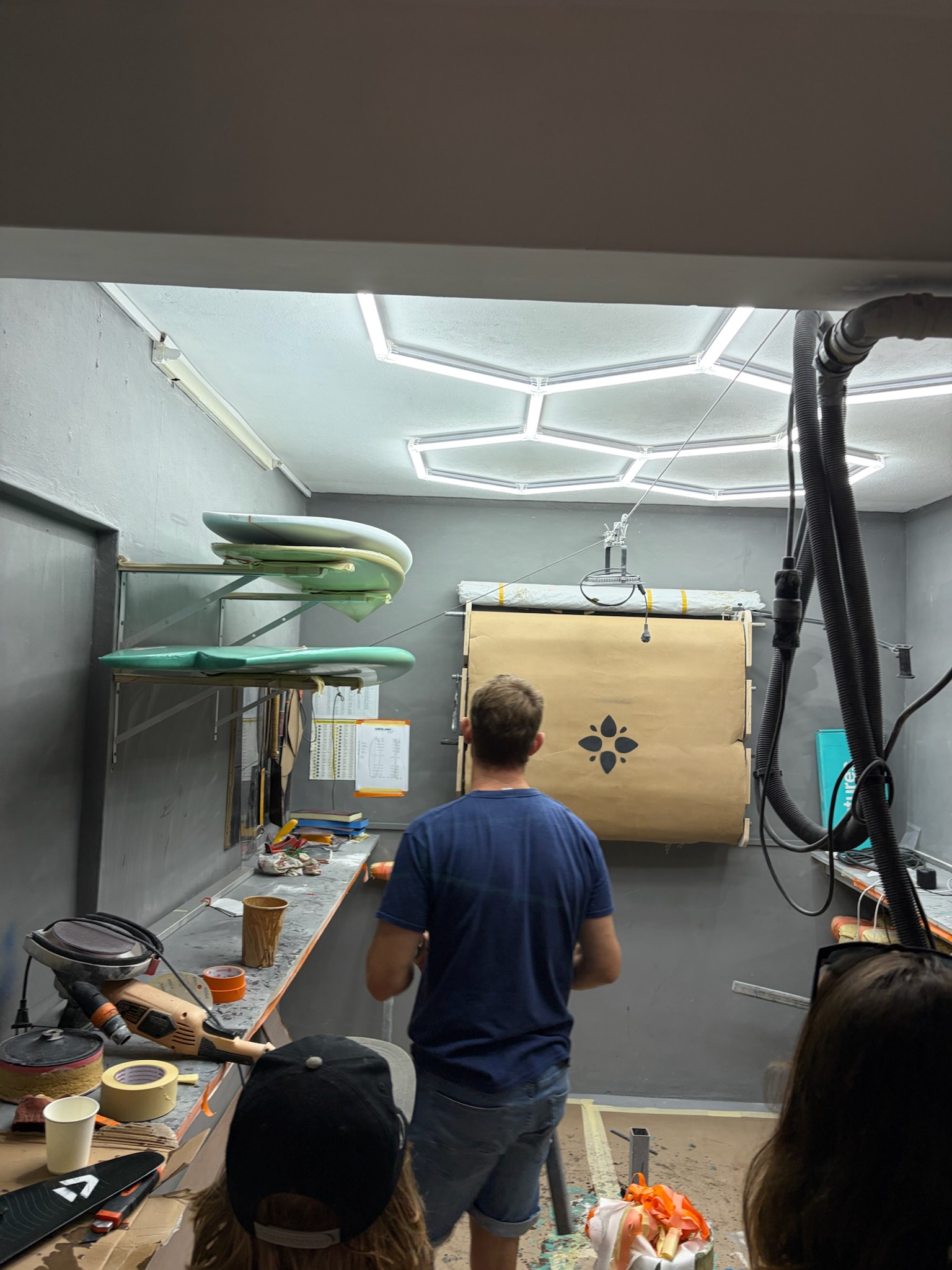
This is what I wanted Noah to see first: the room where the object becomes real. Order online and you jump from checkout page to tracking number and miss the best part, the messy middle where someone with good hands explains why a tiny curve matters.
I spend most of my life in software, staring at screens, wrangling abstractions, building things nobody can touch. The shaping bay is the opposite. Foam dust hangs in the air, a planer chews through a blank, and one of the guys steps back under the angled lights to explain why a rail needs to be an eighth of an inch thinner for our local break.
I haven’t been anywhere near that kind of knowledge in a long time.
I want to build something with my son that can leave the workshop and get scratched in the ocean.
Next up: foam dust, bad sketches, and finding out whether an eight-year-old can care about rail profiles for more than six minutes.