Article · Field notes
The Board Project
25 Feb 2026 24 min read

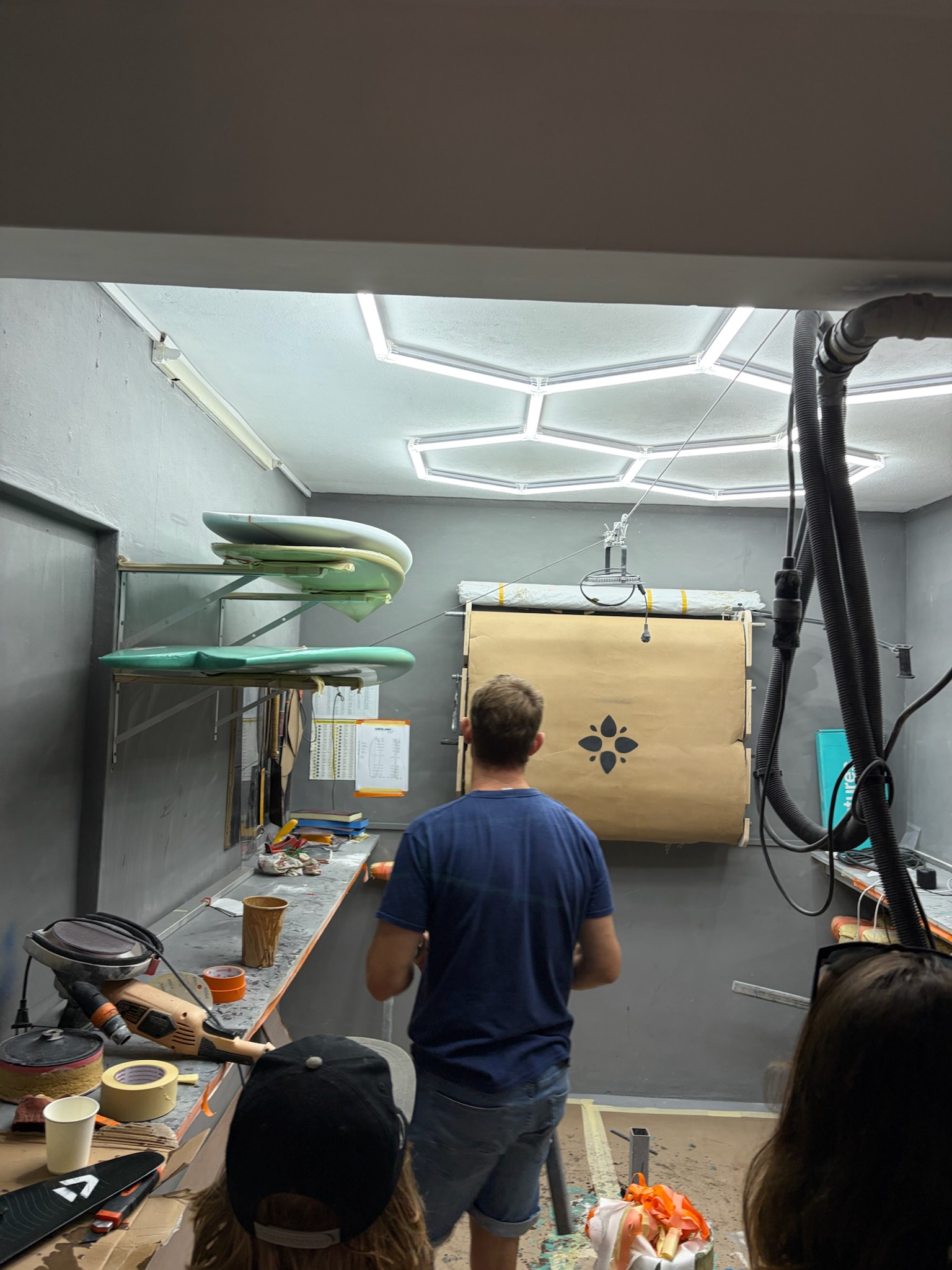
When Noah and I walked into the shaping bay to make it official, one of the guys was halfway through fixing a busted board. He didn’t stop for us. He just talked us through the repair as he went, and Noah stood next to me and watched the whole thing in complete silence.
I took that as a good sign.
The deal itself happened on the phone before that. I called the crew at Santosha, we talked about how Noah actually surfs, and only then did I pitch the project (the backstory is in my last post). By the end we had a rough structure and an agreement that we’d get our hands a lot dirtier than we’d first planned.
The board is ordered. The raw foam blank takes about eight weeks to reach the island, which is a long wait but a useful one: we get to prepare before we touch a single tool. Once it lands, a few weeks of shaping, painting and glassing. Twelve weeks, start to finish.
Noah is 8, so this has to feel like an adventure, not a school curriculum. I also want us to take the craft seriously enough that we walk away having learned something real. We aren’t there to spectate.
The structure
I want this to be something we do together, not one more chore wedged between school and dinner. So every week, we commit to three things:
The rules stay simple: just enough scaffolding that the memories and the lessons stick, and not a plank more.
The timeline
Twelve weeks, three tracks running side by side: shaping, designing, documenting.
First Contact
Meet the shapers. Agree on the dimensions. Order the blank.
Board Anatomy
Daniel takes a board apart for us (with words, not a saw). Stringers, rails, foam densities, rocker.
Design Theory
Why our board is shaped the way it is. How bottom contours and tail shapes boss the water around.
Watch the Masters
Shadowing Daniel while he shapes a different board. Learning how to look at foam.
Graffiti & Flame Concepts
Noah wants flames. Non-negotiable. We study street art and start sketching on paper.
The Posca Pen Dojo
Sourcing the paint pens and practicing on scrap cardboard before we touch foam.
Tools & Tactile Training
Getting a feel for the planer and the surform. Sanding practice on offcuts, where mistakes are free.
Locking in the Artwork
Picking the winning flame design, drawing it out at full scale, one last dry run.
The Blank Arrives (First Cuts)
The foam is here. We fire up the tools and make our first permanent marks.
Sculpting & Symmetry
Sanding. Then more sanding. Trusting our hands to find the symmetry in the rails.
Painting the Flames
Noah takes over. We transfer the art to the raw foam and seal it so it survives the glassing.
Glass, Seal, Surf
Watching the fiberglass-and-resin alchemy, putting the fins in, paddling out.
Week 1: First Contact
Done and dusted. We turned up at the Santosha shaping bay, introduced ourselves, and worked out what kind of board actually makes sense for Noah right now.
Week 2: Anatomy
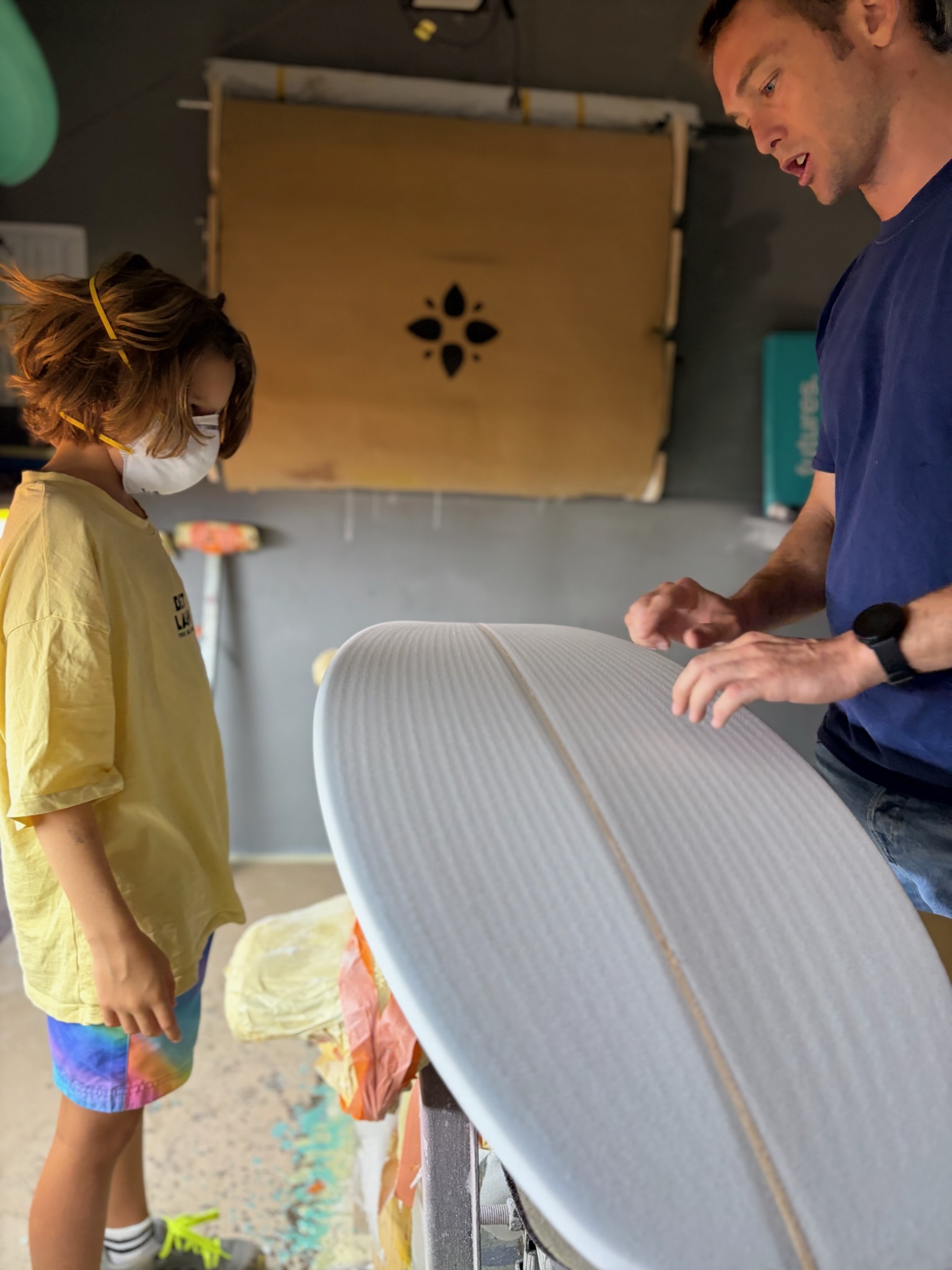
You can’t shape something you can’t name. So first, vocabulary: the parts of a board, what the stringer actually does, why the curve matters. The best way to learn it is with our hands on a real board while Daniel talks.
Checkpoint: If Noah can explain to Lara what a “stringer” is, and get it right, Week 2 is a win.
Week 3: Design Theory
Nothing on a surfboard is there to look cool (the paint job aside). Every curve does something to the water. A concave bottom channels it differently from a flat one. A sharp rail lets go of it faster than a soft, rounded one. This week is the physics of our board specifically.
Checkpoint: Can Noah tell Lara why our board needs a concave bottom instead of a flat one?
Week 4: Watch the Pros
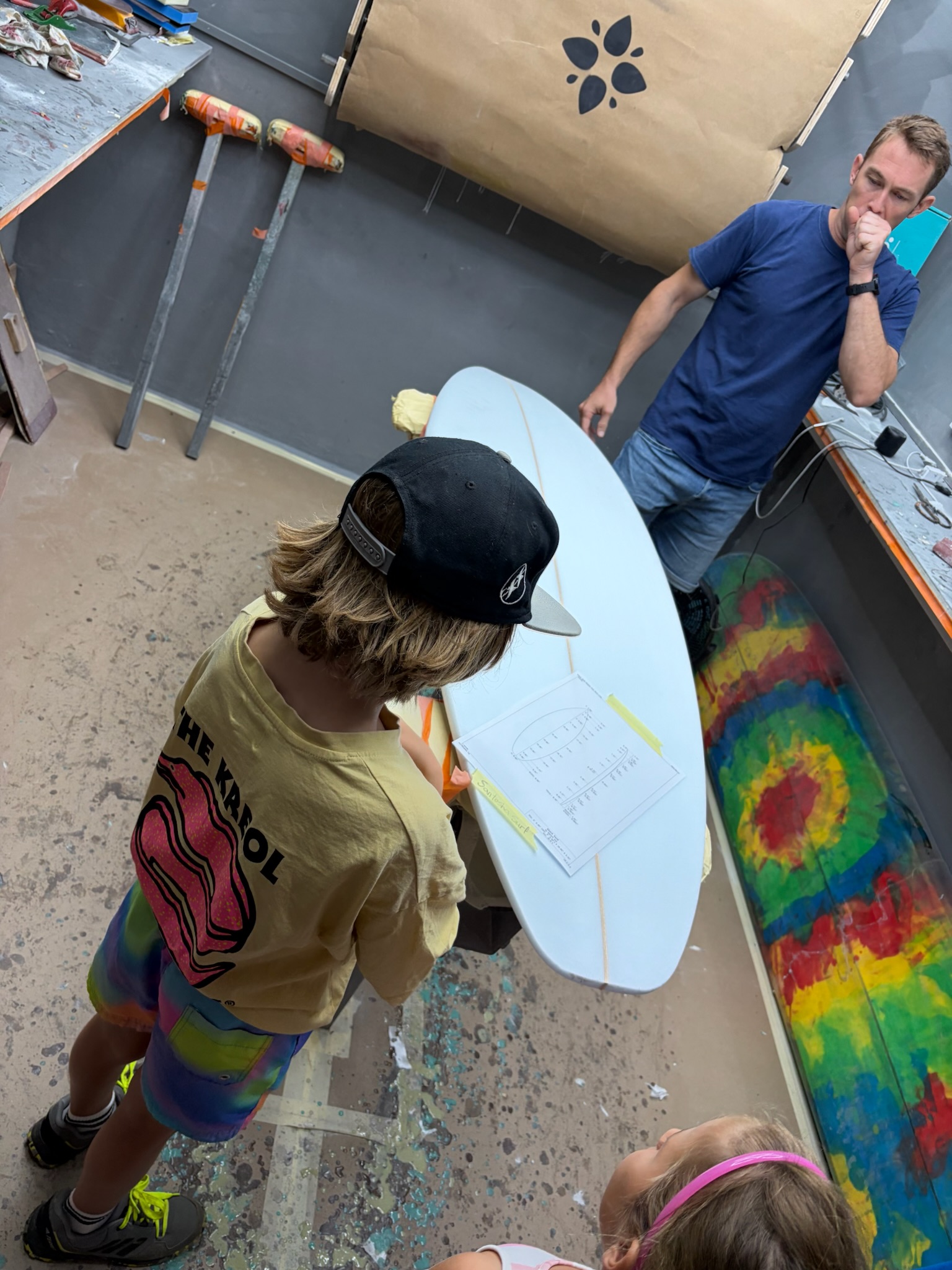
Before either of us picks up a power tool, we watch someone who knows what he’s doing. Our board isn’t involved this week. We stand back, watch Daniel work on whatever’s on the racks, and try to pick up his rhythm.
Checkpoint: Can Noah do a convincing Daniel impression, power-planer stance and all? Bonus points if he knows why the stance matters.
Week 5: Graffiti + Flame Sketches
Noah has been very clear: he wants flames on his board. I’m all for it. But if we’re doing hot-rod flames, we need to work out how street art survives the move from flat paper to a curved, three-dimensional canvas.
Checkpoint: Can he show Lara his favorite sketch and confidently explain why it looks dynamic instead of flat?
Week 6: Posca Pens + Paint Practice
The artwork goes on with Posca pens: water-based, non-toxic, punchy as hell, and forgiving in the hands of an eight-year-old. Paint behaves differently on raw foam than on paper, though, so we run drills on scraps before we go anywhere near the real board.
Checkpoint: Can Noah tell a clean Posca line from a messy, bleeding one at a glance?
Note to self: Posca dries fast but stays water-soluble. Skip a proper seal of clear acrylic and the fiberglass resin will smear the artwork into a muddy blur.
Week 7: Tools + Sanding
The blank is almost here, and we finally get to touch things. Daniel hands us the real tools: power planer, surform, calipers, sanding blocks. Then we wreck scrap foam until we know how much pressure takes off how much material.
Checkpoint: Hand him a surform and a sanding block. Can he tell Lara which one hogs off foam and which one finishes?
Week 8: Lock the Design
Weeks of sketching, and now we commit. Noah picks the winning flame design, and we check it with Daniel to make sure it scales cleanly onto the actual board.
Checkpoint: Can he present the final artwork to Lara and explain why he picked those colors?
Week 9: Blank Arrives + First Shaping
The wait is over. The blank is on the island and sitting on the racks. The shapers take the heavy cuts, and Noah and I jump in wherever they’ll trust us.
Checkpoint: Can he point to exactly where we took foam off today and explain why the board is starting to look “skinny”?
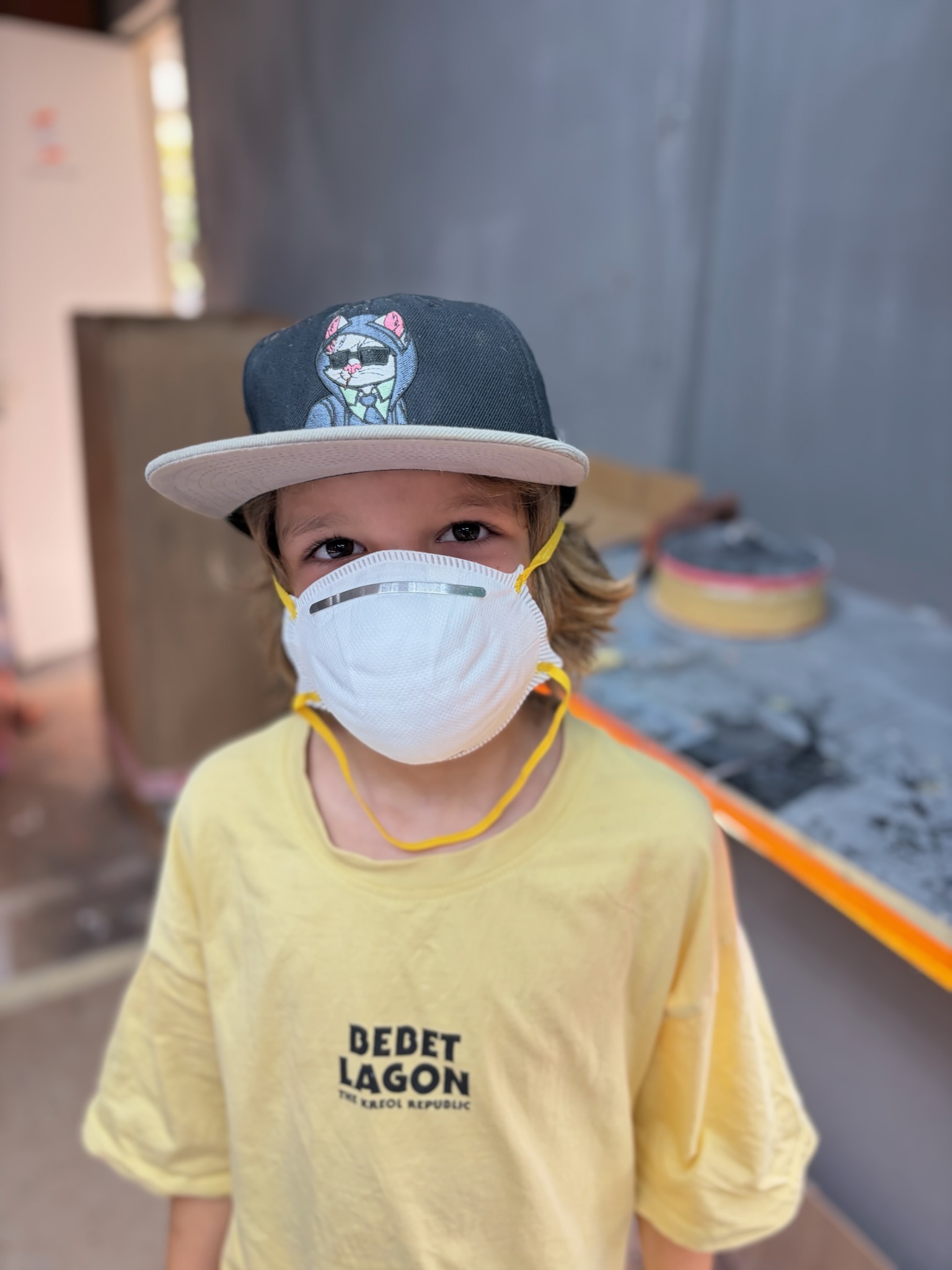
Week 10: Sanding + Refinement
Most of what gets romanticised as “shaping” is sanding. Slow, careful, exhausting sanding. It’s the part that turns a crude chunk of foam into something that slides through water, and this week we obsess over symmetry and foil.
Checkpoint: Can he slide his hands down both rails blindfolded and tell if they feel identical?
Reminder to self: The planer gets you in the neighborhood. The sandpaper buys the house.
Week 11: Paint the Flames
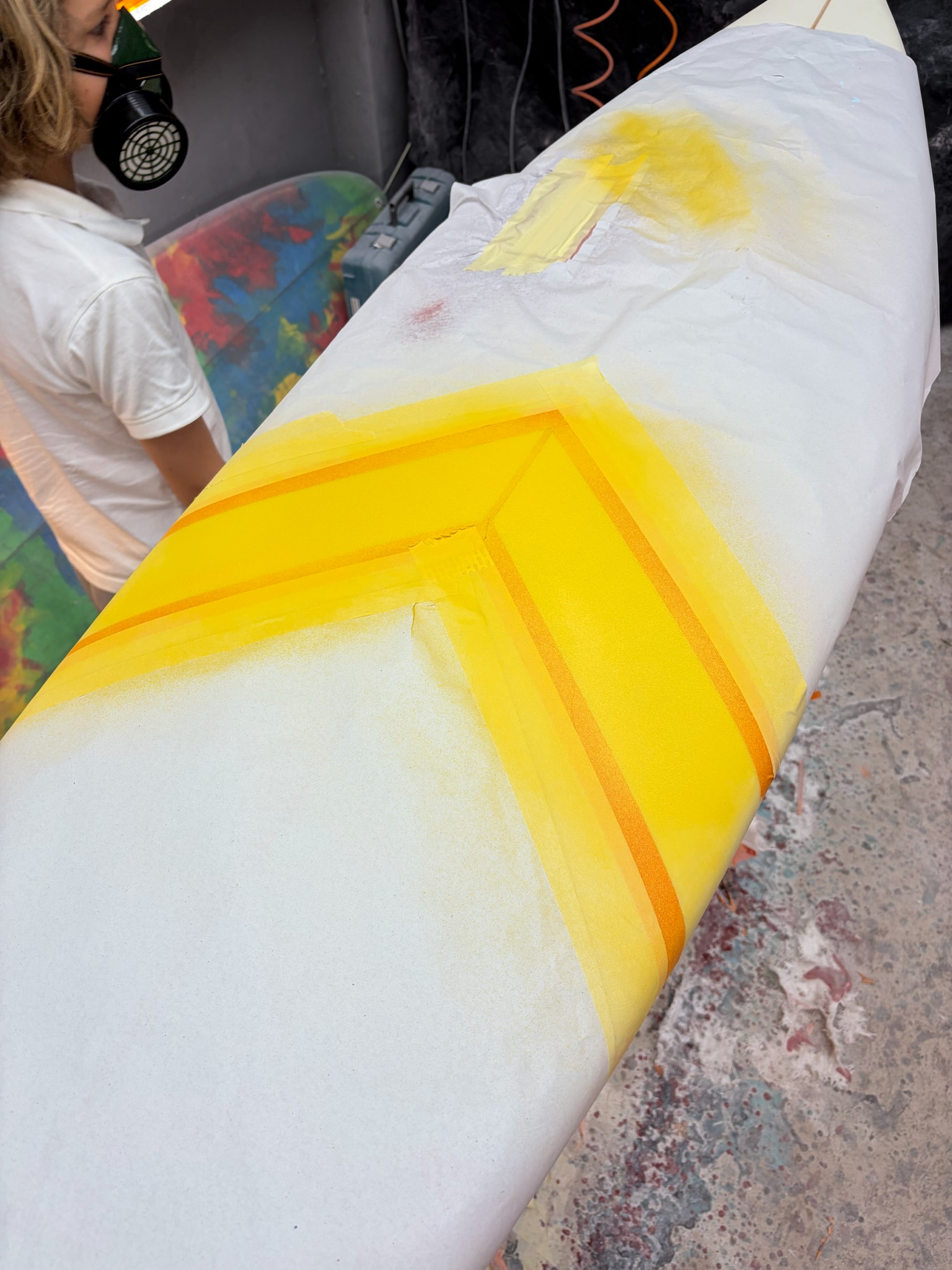
This one is all Noah. We’ve prepped the surface and run the drills. Now he paints the real board.
Checkpoint: The look on his face when he steps back from his own work.
Reminder to self: Do not fix the eight-year-old out of it.
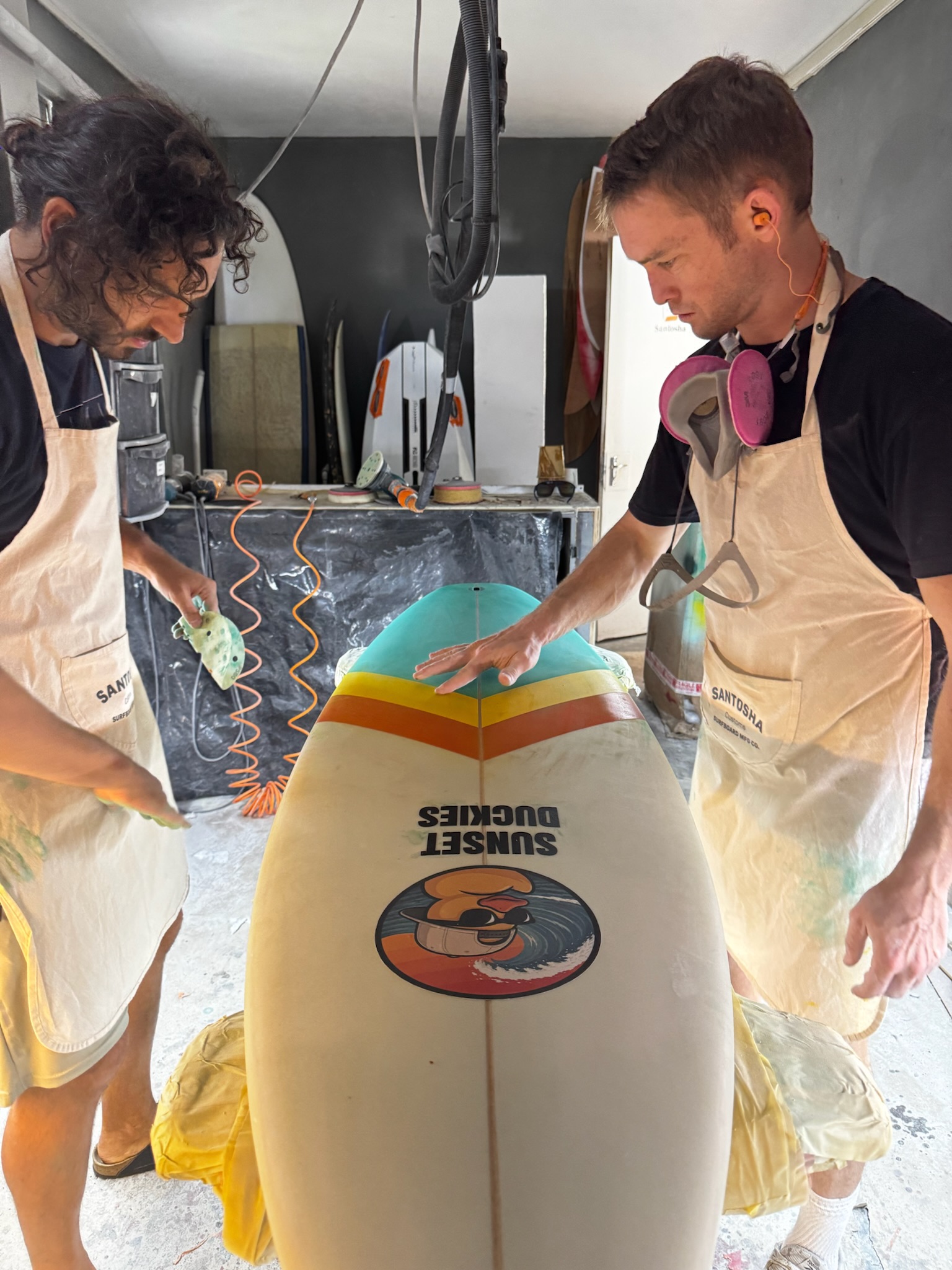
Week 12: Glass, Seal, Surf
Back to the pros. Daniel’s team glasses the board and turns our fragile foam sculpture into something watertight that can take a wave. Then we wax it up and paddle out.
Documenting
This runs alongside everything else, every week, whether we feel like it or not.
For the sketchbook part, I put together a printable journal: one page per week, Noah’s turn and my turn side by side, plus a blank box for drawings. Download it as PDF or open it in the browser.
That’s the blueprint, and I’ll keep updating this log as the dust starts flying.
Noah hasn’t fully clocked the journaling part yet. He just wants to shape a board and cover it in hot-rod flames. For now, that’s enough.