Article · Field notes
The Duck Is Charging
12 Oct 2026 7 min read

Starting a surf club is a questionable way to reduce your workload. Adding a granola project suggests you didn’t understand the assignment.
And yet Sunset Duckies gives me energy. Surfing, making things, getting people together. These take time and make me want to do more with the time I have.
I have ADHD. My brain seems to need a certain RPM to work well. Enough stimulation, enough going on, a certain amount of what feels like adrenaline. When I get that right, I can work exceptionally well. Doing less often makes things harder for me.
Living around that pace can be difficult for people I care about. I want to work hard, build several things and say yes to interesting opportunities. I also want to listen, be empathetic and be there for someone without mentally leaving halfway through. I find that second part really hard.
I’m done waiting for Saturday
The arrangement where you spend five days working and two days being “free” drains me. By Friday you’ve put a ridiculous amount of expectation on Saturday. Now relax. Enjoy yourself. Recover an entire personality before Monday.
Then the weekend arrives, you slump, and somehow you’re still tired. You waited for it, and it gave you very little.
That rhythm doesn’t suit me. I want things I care about throughout the week: work worth doing, people worth seeing, something physical, something unfamiliar. A surf session on a weekday can give me more than another evening spent waiting for the right day to enjoy myself.
A high-RPM life can feel good from inside it. The rush of a wave, growing fitness, an idea I want to try before I’ve worked out whether I’m any good at it. I recognise myself in that. I want to keep that part of me.
But the fact that I enjoy the speed doesn’t make it easy for everyone else. People who love a firm Friday boundary should keep it. My preference for a full week doesn’t give me the right to fill theirs.
One person, several things worth doing
Surfing can leave me ready to tackle a difficult build. A conversation can become an idea. Finishing good work can give me confidence and the means to do something with friends. Duckies sits happily across private life and business, making a mess of the filing system.
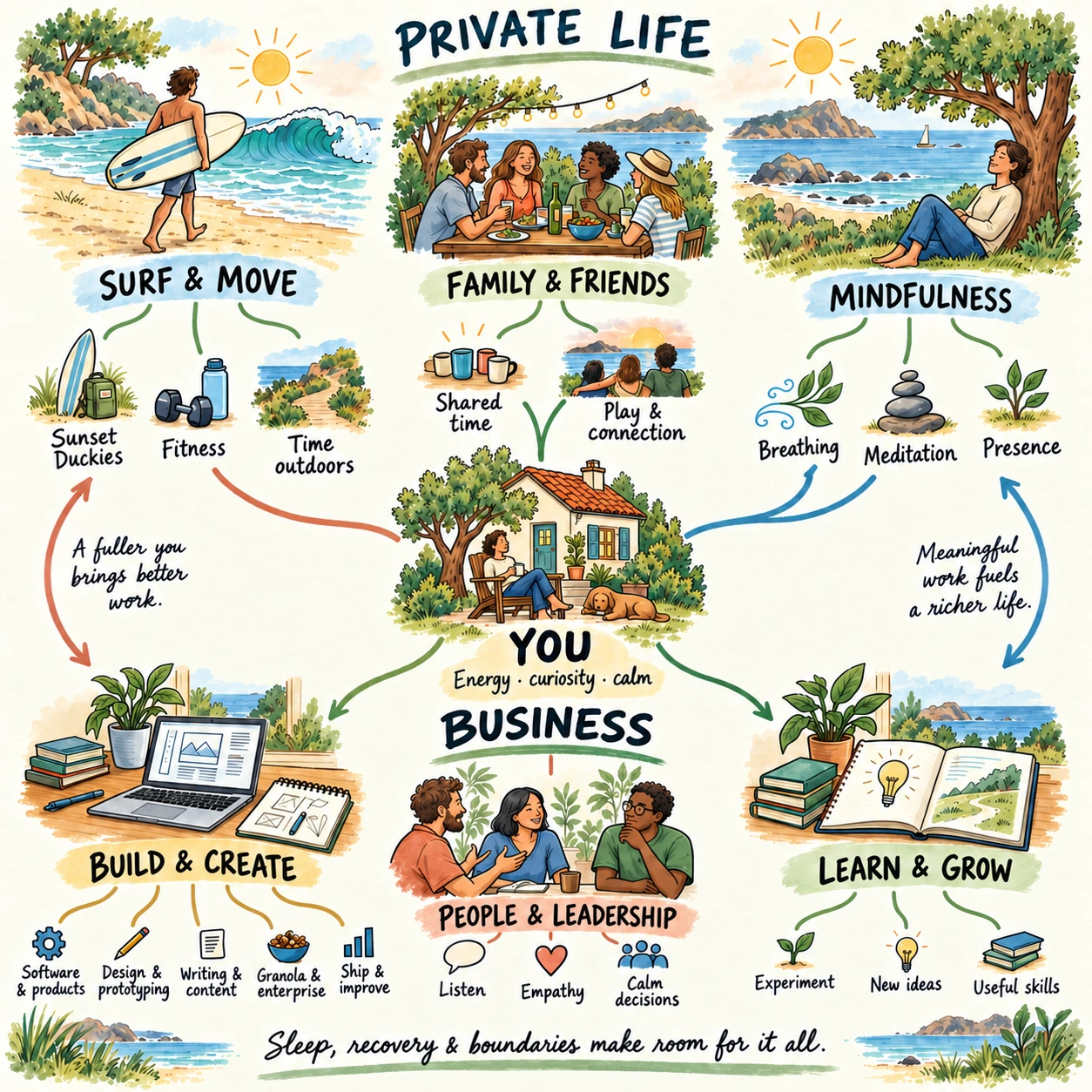
The map looks tidier than living it feels. I want these parts of my life to support each other. Sometimes they compete for the same hour, and someone I love needs that hour too.
Being active helps me. So does having work I’m interested in. That doesn’t automatically make me patient, calm or available. I still have to make time for people and give them my attention. Having enough energy to start another project is easier for me than knowing when to leave it alone.

Saying yes feels good to me
ADHD is something I have to deal with every day. I like my curiosity, the ideas, the enthusiasm for getting involved. I don’t want to spend my life treating those parts of myself as faults. I also can’t pretend that everything they bring is wonderful.
Saying yes gives my brain something to do. Another project, a surf session, something to build, people to bring together. More can make me feel better. Advice to slow everything down misses that part of my experience.
A yes can feel good to me and still make life harder for the people around me. My excitement doesn’t create more hours or make me easier to be with. The people I love have their own needs, their own pace, and a reasonable wish to have me there with them.
I can care deeply about someone and still struggle to be present. That’s painful. Being able to explain it through ADHD doesn’t remove the effect it has on them. They shouldn’t have to compete with everything that interests me to get my attention.
So I need to tone it down sometimes, even when my brain would prefer another yes. That is difficult for me. I want to embrace how my mind works and take responsibility for how I live with other people. I haven’t found a way to make those two things fit neatly all the time.
Learning to stay
This is why I try breathing, meditation and consciously listening. I want to notice the person in front of me, hear what they’re saying and give them room. I want to be empathetic even when my attention wants to run somewhere else.
It takes effort. Wanting to be calm doesn’t make me calm. Deciding to listen doesn’t mean my brain suddenly cooperates. I have to keep trying, and caring about someone doesn’t make the trying easy.
Out in the water, I want to feel the board, watch the next set and be there. Time in nature gives me somewhere to practise being present without needing to produce anything. The ocean doesn’t need a productivity metric.
Breathing and meditation belong in that effort, without an expectation that they’ll fix everything. If I use more intense practices such as Wim Hof breathing, they stay separate from surfing: those exercises can cause fainting and belong seated or lying down somewhere safe, never in or near water or while driving.
Sleep and recovery need room too. Feeling wired doesn’t tell me whether I’ve had enough rest. Neither does wanting to squeeze in one more thing.
I don’t have a finished system for this. Some days the pace helps me do work I care about; it can also ask too much of people I care about. I’m trying to make better choices while living with both. Before the next yes, I need to consider whether I can give it time without taking time I’ve already promised someone else.
Sources used in this article
- Ryan & Deci (2000). Self-determination theory and intrinsic motivation. American Psychologist, 55, 68–78.
- Sonnentag & Fritz (2007). The Recovery Experience Questionnaire. Journal of Occupational Health Psychology, 12, 204–221.
- Puetz, Flowers & O’Connor (2008). Aerobic exercise, energy and fatigue: a randomised trial. Psychotherapy and Psychosomatics, 77, 167–174.
- Noetel et al. (2024). Exercise for depression: systematic review and network meta-analysis. BMJ, 384, e075847.
- Hoogman et al. (2020). Creativity and ADHD: review of behavioural studies and psychostimulants. Neuroscience & Biobehavioral Reviews, 119, 66–85.
- Faraone et al. (2021). World Federation of ADHD international consensus statement. Neuroscience & Biobehavioral Reviews, 128, 789–818.
- Goyal et al. (2014). Meditation programmes for psychological stress and wellbeing: systematic review and meta-analysis. JAMA Internal Medicine, 174, 357–368.
- Almahayni & Hammond (2024). Physiological and psychological outcomes of the Wim Hof Method: systematic review. PLOS ONE, 19, e0286933.
- Van Dongen et al. (2003). The cumulative cost of additional wakefulness. Sleep, 26, 117–126.
- Wim Hof Method. Official breathing safety guidance and FAQ.
Paper titles are shortened for readability. Both photographic images are AI-generated scenes; they don’t depict the author, actual Sunset Duckies participants or real club events.