Article · Field notes
Gaussian splatting in Baubiber, and the slightly absurd state of 3D worlds
20 May 2026 6 min read
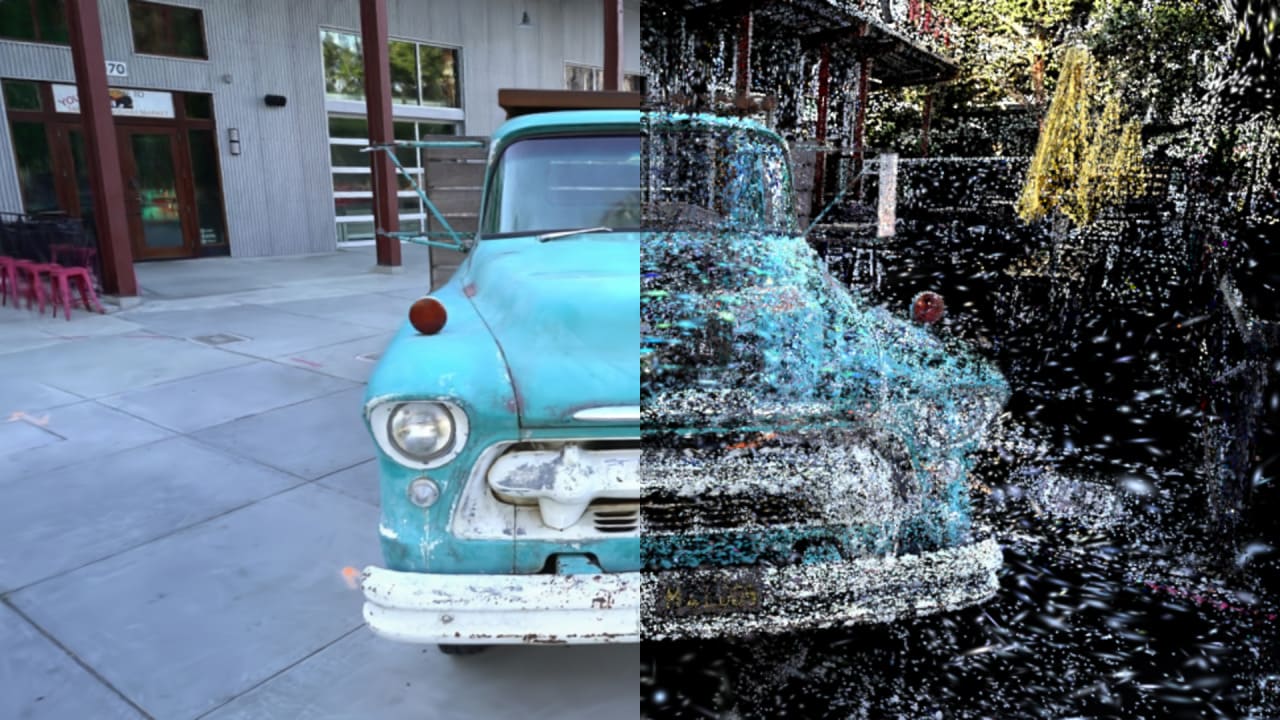
A few weeks ago I shipped a feature into Baubiber that I keep playing with even when nobody’s asking me to. You scan a room with your phone, and the contractor on the other side of the marketplace can walk around inside it in a browser tab. It isn’t a 360 photo, or a Matterport tour with floating arrow-pucks. It’s a walkable cloud of a few million coloured blobs that, from the right angle, looks like a kitchen.
The technique is called Gaussian splatting. The paper that made it run in real time came out in 2023, which in this corner of the world is geological. Roughly: instead of building a 3D scene out of triangles and textures, you represent it as something like a million fuzzy little ellipsoids floating in space, each with a position, colour, opacity and a stretched shape. Then you sort them back to front and paint them onto the screen. A counter isn’t a modelled object in this setup. It’s a few thousand blobs that happen to line up when you look from where I was standing.
It is, by any sane standard, an absurd way to do graphics. It also happens to solve the job in front of me: a contractor in Pécs needs to see a kitchen in Tamarindo without flying there, and a photograph isn’t enough.
A video walkthrough doesn’t quite get there either. Video gives the contractor what I happened to look at. A splat gives them what they would have seen standing where I stood, then taking three steps to the right and crouching. It’s a different shape of artifact altogether.
Why this fits the construction problem
Construction is a perception problem in disguise. The homeowner is standing in the kitchen, the architect is in another city, the plumber is in a van somewhere between two other jobs, and all three need to see the same room accurately enough to make a decision. The current chain for getting there goes roughly like this:
- Homeowner takes 14 photos, 6 of which are blurry, none of which show the corner with the boiler.
- Architect asks for “one more shot of the X”. Three days pass.
- Plumber visits the site, takes their own photos, quotes anyway, charges for the visit.
You can crank up the photo count and the messaging frequency forever and you’ll still lose information in the compression, because the room is volumetric and the medium isn’t. A walkable splat closes that gap badly. But it closes it well enough that a contractor can bid without first driving an hour each way to see the site.
How bad the splats actually are
Quite bad, in ways that get more interesting the more you poke at them.
Walk three steps out from the centre of a captured room and the geometry starts to soften, with corners quietly lying to you about where they are. Reflective surfaces (mirrors, glossy floors, anything chrome) confuse the model completely, which is why one of my demo kitchens has a phantom second oven floating off to one side, where the toaster’s reflection used to live. Specular highlights smear across the screen as you move your head. The ceiling sags by a centimetre or two if I didn’t scan it carefully enough. And a serious room runs to several gigabytes, which is fine on a laptop and painful on a building site with two bars of signal.
I love them anyway, because the bad bits are exactly what the papers are already chewing through. Every new release either compresses the splats, generates them from fewer photos, or patches the holes the current ones leave behind. The room keeps getting lighter to send and easier to trust.
The world-model branch
The version of this getting the most attention right now skips capturing the room altogether. World Labs in particular has been showing demos where you hand the model a single still image and it invents the rest of the scene, including the geometry behind the camera. A few worth poking at:
- World Labs’ demo wall, Fei-Fei Li’s outfit. Single image in, walkable scene out.
- Marble, their product, where you generate and edit scenes from a prompt or photo.
- Luma AI’s Interactive Scenes, if you prefer the captured-from-reality flavour.
These are very early. Marble gives you a room you can wander around for maybe ten metres before the model starts inventing increasingly committed staircases. The demos are short, soft at the edges, and break in funny ways. They’re also good enough that I spent a Sunday afternoon on an invented Tuscan terrace and forgot I was sitting at a kitchen table in Switzerland.
For Baubiber the world-model branch isn’t useful yet, because I need the real kitchen rather than a merely plausible one. But squint at where it’s heading and you can see a near future where the homeowner takes a single photo of a corner, the system produces a walkable approximation of the whole room with the contractor’s confidence interval baked into the rendering, and that’s enough to bid against. We’re not there yet. We will be soon enough.
Go and stand inside one
Whenever this comes up at dinner, I end up saying two things.
First: if you’ve never walked around inside a splat, go and do it this week. The first time your body registers that you’re inside a place you’ve never physically been is properly strange, and it quietly changes how you look at photographs for a few days afterwards.
Second: don’t wait for any of this to get polished before you do something with it. The interesting use cases get built now, while the tech is still bad enough that nobody’s sure what it’s actually for. Baubiber is one of them. There’ll be a dozen more in fields I haven’t thought of yet, built by people who got their hands on the SDK in 2026 and decided to ship something inside a three-metre cube before the cube was anywhere close to reliable.
The splats are bad, and I’m still shipping them.
Want to talk gaussian splatting, construction, or both? X / LinkedIn